My friends and I wandered down to Kyoto this weekend... the trip was a little short to fully see everything Kyoto had to offer, but we had what I like to call, "The Geisha Experience."
Admit it, the first thing you thought of when I said Geisha was either "expensive prostitute" or "Memoirs of a Geisha"... If I was wrong about those two, you were probably thinking about about food or wondering where I was going with this. I'll tell you where, dear reader! I'm about to learn you some Geisha facts.
Becoming a geisha (or "geiko"... no, not Gecko...) is actually a very difficult process. For one thing, geisha are required to master dancing, singing and playing musical instruments. They are considered to be top entertainers and the training can take up to 5-6 years. Young women (usually between the ages of 15-18) who become apprentice geisha (called maiko, pronounced like my-ko) have to be interviewed and accepted by an Okiya (sorta like a boarding school for geisha).
You can tell the difference between maiko and geisha based off their makeup... and you can also tell the difference between the girls pretending to be geisha and the real deal allegedly off of makeup/attire, but I had trouble figuring it out. It seems like someone with money to burn could imitate the real deal quite well but what do I know! At any rate, some of the differences are:
1. Maiko make up their own hair and geisha use wigs (also their hair pieces are informative to their status)
2. Experience = sophistication. Thus, a more sophisticated (i.e. less gaudy) look means they're more senior. I found this fairly difficult to ascertain.
3. Their hair pieces are usually seasonal (so right now, it'd be cherry blossoms)
4. There are a ton of random people chasing them taking their photos, a la the papz!
To be entertained by a geisha requires an introduction by someone else who is already established with the particular geisha community. That means more selective clientele, and if you act like an ass, they can complain to the person who recommended you and that just creates a whole ton of embarrassment that no one wants to deal with. As a result, I will probably never be able to see a private show with a geisha.
As a side note, geisha are not considered prostitutes...this was propagated during WW2 when Japanese prostitutes would call themselves "geisha girls" to the soldiers, who obviously can't tell the difference.
On to MY adventure, the most important part!
My friend was smart enough to find out that there was a special performance put on during the month of April called "The Cherry Dance" (Miyako Odori in Japanese), performed by real live geisha and maiko! We bought the ticket that also included a viewing of the tea ceremony, a free snack and a free plate. It was pretty awesome to see a real geisha (?maiko) doing it in person, since you normally require the ever evasive "connections" to see it.
I also took a picture of my food, per Colin's request (it was green tea and a small pastry filled with bean paste). We got to keep the plate!
After that, we were ushered into the theater to watch a play (Miyako Odori). It was composed of 8 scenes all portraying different seasons (and a myth to go along with it). Despite being in Japanese, it was very impressive... though the music was at times a little jarring for my Western ears, but it was beautiful in its own way. We weren't allowed to take photos, so none for you!
After that, we went on a Geisha Walking Tour, done by a white guy who frequents geisha establishments (and at one point was married to one... the geisha, not the establishment). Though it might seem sketchy at first, it was actually pretty interesting. He was one of the advisers for the movie Memoirs of a Geisha, so we got to see some of the places they used in the movie.
This was in front of one of their tea houses.
Supposedly the most expensive tea house in Kyoto.
Walkway for some of the tea houses or places the geisha entertained.
On to the actual street-geisha pictures! Unfortunately, we were like the paparazzi so they didn't really let us stop them to take good photos. In fact, they actually started picking up the pace when our cameras came out! I don't think I could ever be a pap... too freaking weird and invasive.
Yeah, that picture isn't creepy at all...
That was it for the geisha experience, but it was definitely informative!
The other fun facts I learned on the tour (not related to geisha) were related to dog pee. Yup.
The little torii gate is placed there to discourage people from letting their dogs pee on a sacred symbol. I guess this only works if you believe in it though.
The bamboo was there so that if a dog did decide to pee, it would ruin the bamboo and not the nice wood wall. I guess they still decided to use the right side of the real wall though...
You now know more than most people about the secret world of geisha... you should feel special!
What?! Two posts in one weekend? I'm feeling generous and I kinda like you cuz you're so cute, so don't say I never do nothing for ya.
My goal this time was to see one of two shrines that allegedly started the Maneki-Neko ("Lucky Cat"), but I randomly wandered into another temple and spent more time there than I should have. I know, right? So the second Lucky Cat shrine will have to wait (and it's closer to Atsugi, anyway)... I'll save the first one for another blog post when I've seen the second shrine.
Naturally, the temple I randomly wandered into is actually one of the most famous Tokyo temples because it's one of Tokyo's oldest temples (built around 628 A.D.). Its name? Senso-ji temple.
The story of Senso-ji's creation involves two young fishermen (Hinokuma Hamanari & Hinokuma Takenari) who were out fishing and drinking beer when they thought they caught the big one. As they pulled up their nets in anticipation of re-telling their fisherman story to the local ladies, they realized they'd pulled up a statue. Deciding it might be something important, they brought it to their village leader Haji no Nakatomo, who realized that it was an important Buddhist deity (Kannon, Bodhisattva of Compassion), and thus a temple was created. Why was a statue in the middle of this river? Who knows.
Painting of the brothers doing their fisherman thing
Unfortunately for us mere mortals, a Buddhist priest later decided that statue should be hidden from human view For. Ev. Er.
An interesting connection to my post on Nikko was that the Shogun Ieyasu decided to make this the official place to pray for the shogunate. Coolio!
When you get to the temple, you first come upon the Kaminarimon Gate, also known as the "Gate of Thunder". It's called this because the God of Thunder and the God of Wind are on either side of it... because I took their photos back in Nikko, I will spare you this time. The gate itself was created by the commander Taira no Kinmasa, and was used by people to ask for protection against typhoons and tsunamis. That being said, the gate was burned down. I guess it didn't account for fires. The red lantern in the middle is well-known to those in Japan.
After that, I wandered down a street of shops known as Nakamise Dori. For whatever reason, this was a massive little (oxymoron?) street vendor area that was selling a bunch of random Buddhist stuff. Probably good for tourist souvenirs but nothing really caught my eye.
I just liked this picture because of the old guy giving me the stink eye, ha.
The blossoms were beautiful leading up the next part of the temple, as well.
Next is the Hozomon Gate (Niomon Gate). Remember the Nio I told you about before? Yeah, they're here again to protect the temple!
On the opposite side of the gate was a pair of giant sandals called O-Waraji, and apparently act as a charm against evil. I guess if you touched it, you gained protection, but it was pretty far up there.
After that was the Main Hall, which contains the statues of Kannon. For some reason I didn't really take a photo of that, so I guess you don't get to see it full on. Ha.
But I did take a photo of the incense smoke that people would waft on their bodies to ward off illness. Despite being a medical professional, I did it too. Hey, you never know!
Off to the side of the Main Hall were a bunch of smaller temples and statues. Below is the bronze hokyoin-to, which is a pagoda based on a Buddhist text called Sutra of Casket Seal Dharani (Hokyoindarnikyo). Its importance is in the fact that it provides evidence of casting techniques used in the 18th century. Right next to it was a Buddha statue, but my photos of it didn't turn out well since people were actually using it to pray.
The Saibutsu Itabi is a monument "that reveals medieval religion". Inscribed on it is a syllable representing Syaka Nyorai (not sure who that is) and below that is the syllable image of Jizo Bosatsu standing on a lotus base. It's all very exciting.
The blossoms were in full bloom here... these were taken at a temple for the protection of women.
Next up is the Demboin garden, planned by Kobori Enshu, a famous garden planner (I wish that was my job). To quote the pamphlet, "If we walk around it, we can enjoy watching various scenery." It was actually a really pretty area that used to only be open to the rich and famous, and even now has a very limited season (March 21st - Mary 7th), though apparently you can always ring the doorbell to be let in. I'm serious, Frommer's said it.
You can see the five-storied pagoda in the above photo, but here's another shot for your viewing pleasure.
Next was the Asakusa Jinja shrine, built to honor the two brothers who found the Kannon statue. Lucky dudes.
I also saw statues of two Buddhas sitting next to each other. The one on the left gives mercy to worshipers, and the one of the right gives wisdom. Can I take a little of both?
They also had a "bell that announced the time" (sorta like a clock chime) that used to be used to help the locals tell time.
I have no clue what that little Jizo guy is about, but there you go!
Overall, a pretty neat temple despite its tourist-trap vibe. A sad point to note is that most of the original buildings were destroyed in the Tokyo bombings during WWII. I'll leave you with a view of the Tokyo Skytree as seen near the temple.
Okay, so I didn't go anywhere exciting over the weekend (too busy trying to figure out my new house), so I figured I'd satiate your desire for a new post by talking about a few things I've noted regarding Japan vs America.
1) Everything's Based on Respect. Japanese people are BIG on respect and saving face. For instance, if someone trips and falls, no one will try to help them... not because they don't care, but because by not acknowledging it, it's sorta like it never happened. It's even in the wording of phrases... when I gave a gift to my neighbors (a custom for new people moving into a neighborhood), I asked one of the translators to write me an introductory letter in Japanese in case they didn't understand English, and she explained how she had to word it so that I was speaking as a person in lower status than the person receiving my gift.
...which brings me to...
2) New Neighbors Bring Gifts. I think most of my US friends are aware of the (semi-outdated) custom of bringing a gift (usually some half-stale fruit cake) to a new neighbor moving in... well, in Japan, it's the other way around. The new person brings gifts to their neighbors. I did it to my neighbors, bringing around some "American" chocolates. I was told they prefer American candy because it's exotic since the language it is written in is English, rather than things like towels or soaps (usual Japanese gifts). I think this custom may be more popular with the older Japanese crowd though. No word yet on if my neighbors were impressed.
3) Credit Cards Are Not Cool. America is very credit card friendly... it's almost impossible to find someone who has actual cash on them. In Japan (and Australia, for that matter), they are very anti-credit card. I'm not sure why. All I know is that it gets frustrating when you realize you need to go to the ATM to get yen because the restaurant likely doesn't accept credit cards. There have also been some scams involving a few clubs in Tokyo, where they steal your credit card information (this is mostly Yakuza, or gang-related, activity). That sort of thing doesn't usually happen in clubs in America. Or at least I like to think not... but I'm just a naive young pup.
4) Public Transportation. Yeah, unless you live somewhere like NYC (or Nueva York, as I saw on a t-shirt), the public transportation in America kinda sucks. It's very easy to get around here and go almost all over Japan, but the only gripe I have is that it ends at midnight. In America's defense, I will say that some cities are not as densely populated as Japan, making some forms of public transportation less likely to be used. In Japan it's very difficult to tell the end of one city and the beginning of another, which means it's easier to get around via public transportation.
5) Cutesy Everything. Everything that is anything is animated in some sort of cute way. I have no idea why... I'll admit that seeing a police station with a policeman drawn as a cute animal character makes me much more happy.
6) Cars and Roads are Small. Cars are tiny. I have a Nissan Cube and that thing is not the American version... cut it in half and that's the Japanese version. Seriously. And there are roads here that should not be two way streets. I'm scared. Really terrified. I've already messed up part of my car trying to hug the wall so that a second person could drive by me with less than an inch between us. Ugh.
7) Anime Is Not Cool Here. Yeah, you heard me. Only weirdo geeks like anime here, and they tend to sell pornographic figurines of anime female characters to these outliers... obviously I'm stereotyping, but for the most part anime is not a very mainstream thing like you would assume. And the figurines are real; I've seen them at thrift stores and in Akihabara, and they can be very pornographic.
8) Female Fashion Is Short Skirts or Shorts with Tights That's all. In regards to the tights with shorts, I mean.. they also wear cute t-shirts. Usually the tights are black, but lately I've been seeing skin toned with tattoo like things on them.
9) Central Heating Is Nonexistent. This is probably the most annoying thing about Japan... their winters are fairly chilly (30s for where I am), and NO central heating of any kind unless you wish to spend exorbitant amounts on electricity bills. Alternative forms of heating yourself are warm water bottles you put in the bed (yes, Little House on the Prairie style), the kotatsu (which is a table with a heater underneath it) or the kerosene/electric heater option.
10) Laundry Is Hung Out to Dry. I saw this in Australia, too. They don't like to use dryers because it's not environmentally friendly... so they hang their stuff to dry. They also hang their futons to air, which are not the American version of futon. These are little mattresses they place on the floor and then roll up to put away.
There's a lot more differences but these are the big ones I've noticed so far... I'll save the next part for another time!
Part 2 of the Nikko adventure! Read Part 1 to catch yourself up if you’ve got the
memory of a goldfish or just didn’t plain read it. The nerve.
Toshogu Shrine is the most popular, for good reason. It
contains the enshrined Ieyasu, first off. The next reason is the ever
famous three wise monkeys. Never heard of them, you say? How about the phrase,
“See no evil, speak no evil, hear no evil”? I thought so. That original carving
is here, and is actually part of a story line of the life cycle of the monkey.
“A mother monkey is looking far into the future of her
child, and a child is looking up at the mother.”
“Three monkeys tell us that children should see no
evil, say no evil, and hear no evil.”
“He is about to be independent.”
“He is ambitiously looking up”
“He is frustrated in life and desperately looking down
the cliff while one of his friends is cheering him up.”
“He is love sick.”
“A newly-wedded couple are going to sail through the
rough waves of life together.”
“She is an expectant mother, and return to the first
scene.”
This same building is actually the “Sacred Stable”, which holds
two white horses (alas, none there when I was by). The monkeys are thought to
be guardians of horses, hence their presence.
Across from that were the famous “Imaginary Elephants”
carved by the sculptor Tanyu Kano. He made these without ever seeing one
himself (just based off descriptions). Not too bad, if I do say so myself.
Below is a picture of the first bronze Torii in Japan,
called the Karadou-torii. I guess at the base were lotus flowers, which is
apparently strange because lotus flowers are associated with Buddhism. I forgot
to look for them, so no pictures.
At the top of the stairs are two statues of lions that
appear to be jumping… but they actually serve a purpose! Apparently they are
used to stabilize the fence. Those crafty Japanese, combining style with
function.
Next is the famous Yomeimon Gate. It has a lot to notice, such as the multitude of carvings on it which I managed to photograph for your
viewing pleasure.
Dragons, probably Kirin though
Bad photo of a dragon, but it may actually be a
giraffe. I know, it’s weird.
This isn’t a very good photo, but the pillar in the center of the photo is inverted (called the Mayokeno-sakabashira) – if you look at the
design, it’s upside down compared to the two on the left. It was believed that
“once a building is completed, its destruction begins”, so they purposely
placed it upside down to act like they were permanently postponing the shrine’s
completion. I think the gods saw through that one though.
Iki or dragon on top of the Karamon Gate, located after the Youmeimon Gate. This serves at the gate for a worship building called Honsha, which used to be limited to only feudal lords or higher. The picture below is a close up.
To see Ieyasu's tomb and another famous carving (Nemuri-Neko, or Sleeping Cat), you have to pay an extra fee... or, you got a combination ticket when buying entry into Toshogu Shrine. Guess who purchased the combination ticket but also paid extra because she stupidly didn’t realize that her pass was the combination one? Oh well, I guess the Buddhist monks need it.
The sleeping cat is famous because it signifies the peace in
the land… there’s a sparrow on the other side that can feel free to fly without
getting eaten because the cat is sleeping. Unfortunately, I thought the sparrow
was on the image with the cat… but luckily someone else online thought to take
a photo of the sparrow, so I will shamelessly steal it for your benefit.
FUN FACT - The sculptor (Hidari Jingoro -- famous in Japan) apparently spent 8 months mastering the art of cat carvings to make this sculpture as accurate as possible.
I then made the trek to Ieyasu’s tomb.
His remains are in that cylinder, guarded by the crane and a turtle (symbols of good fortune and longevity). The tree in the background was special and brought some sort of good fortune, but I couldn't find out what.
There’s another part of the shrine where you can hear the
“crying dragon”. It’s an awesome acoustic effect, though I’m not sure why in
particular since the room is fairly square. There’s a giant mural of a dragon
on the ceiling, and if you clap two sticks anywhere in the room except for
under its head, you hear just normal clapping. However, if you clap the sticks
under its mouth, you hear a loud echoing sound, which sounds like a crying
dragon. Or at least, it did to me… though the last time I heard a crying dragon
was a while ago. If you skip to the 3:00 minute mark, you can get the basic idea:
The Five Storied Pagoda, standing in at 36m high. It’s
hollow inside. That’s all you really have to know.
Exhausted and hungry, I made my way back to the hotel, but
not before stopping in another little tiny restaurant owned by an older
Japanese couple. The woman was super excited to help me out and gave me a
thousand brochures on things to do in Nikko. They served me up a wonderful soba
made of Yuba, which is the skin that forms on top when making tofu (Nikko is
famous for this). The woman also wanted to take a photo of me and put it in her
little photo album of foreign visitors, ha. Below is me and her (I'm assuming) husband, the chef.
The next day, after perusing the brochures the lady from
last night had given me, I realized I had been unaware of an entire section
called the Takino’o Path! Thus, I returned to the temples for more.
This is a three-storied pagoda, which apparently has
12 zodiac animals carved under the roof of the first story (forgot to look) and
the Kannon-Do Sacred Hall, which is where Senju-Kannon (1,000-armed Goddess of
Mercy) is enshrined.
Kodama-Do Sacred Hall is where, according to legend,
Kobo Daishi saw two white balls come out of a pond. Believing that they were
incarnations of holy spirits, he built a temple for them. Those balls pulled a
number on him, eh?
Kaizan-Do Sacred Hall is where the body of Priest
Shodo was cremated.
Next to that is his grave…
…along with his three disciples
Right next to it is the Kannon-Do (or San-no-miya),
which is the Shrine of Safe and Easy Delivery of a Child. Another name is
Kyosha-do, because Kyosha is a piece in Japanese chess that can move forward in
a straight line. I’ll have to take their word for it. The connection between
the two is a straight & easy path toward delivery.
Behind that was the Hotoke Iwa, which contains six
stone statues of Buddha (called Rokubu-te). They were pretty cool, and it was
weird to just see these statues under a cliff.
That last one kinda scares me.
The Yin and Yang Stones, symbolizing male and female. I
don’t know how this ever became something important, but I’m sure there’s an
awesome back story.
This is the Kitano Shrine, built in 1661 for Sugawara
Michizane (enshrined as a God of Study). At first I thought it was a pig but I think it's supposed to be a bull. After some research I found multiple reasons why this is so, but I'll only list one particular to Michizane. I guess the bull pulling his remains during the funeral procession refused to go past a certain spot, and thus a shrine (Kitano Shrine -- though not this particular one pictured) was built.
The Tegake Stone, something I wish I had known about when
I was in medical school, because by touching it or scraping a piece off to
place on your family altar, you can improve schoolwork or handwriting. I
decided to touch it because I don’t own a family altar. Hopefully my future
studies will be successful, or maybe my handwriting will remain semi-legible.
This is the Monument of Dai-Shoben Kinzei and it
literally is there to tell people not to take a pee or poop on the land because
it’s sacred. Obvi.
After that were the Shiraito falls. It’s famous because it
appeared in the book of Kaikoku Zakki, because otherwise I’m not sure what is
so awe-inspiring.
I took a photo of the stairway because it reminded me of
something you’d see in Lord of the Rings. No elves today.
This is the Undameshi-no Torii. The “undameshi”
portion means “try luck”, which you do by trying to throw pebbles through the
hole for a max of three attempts (if you get it, you are going
to be lucky, multiplied by the number of stones go through it). I tried five times, and my natural lack of athletic ability
foiled me again.
The romantic patch of bamboo called Enmusubi-no-sasa
(“match-making bamboo”). If a couple can tie the paper to the bamboo using only
their thumbs and little fingers, they can get married.
Someone’s getting married!
Kitsune guarding the Inari shrine, located behind
the Enmusubi-no-sasa.
These trees are
called Goshinboku (giant sacred trees), because deities live in the trees. Kicker is that the original
trees fell down 250-300 years ago. Shameless.
This might be one of the originals.
Sake-no-izumi… or, the Fountain of Sake. Just like the
Yunessun, not really a fountain of sake, but apparently worshiped by sake
brewers because of the excellent sake that this water produces. I hear the coins in
the water probably add to the taste...
The Kodane Stone is believed to have the power of
child-birth. That’s the direct translation from my brochure, though I think it
means the power to make someone pregnant. I didn’t touch that one.
This is the Gyoja-do Sacred Hall, which contains the
enshrined En’no Ozunu (founder of mountain ascetics in the Nara period)… sorta
like that mountain worship I was telling you about earlier. Gyoja means
“ascetic” in English.
It’s guarded by little monkeys, I think!
Inside, you can see En’no Ozunu and his followers.
Kinda scary.
Ku’en Jizo is the “Guardian Buddha”! He’s named after
Tadaaki Abe (Ku’en is his posthumous name), who was the 3rd shogun
Iemitsu’s aid. He was apparently known for his integrity and high morals and helped keep the government (mostly) corrupt-free. This one gets water to keep hydrated.
And I leave you with a cool sculpture of a dragon spitting
out water...
...a duck in a pond...
...and a telephone booth.
There’s a quote about Nikko that states, “Never say you’ve
had enough until you’ve seen Nikko”. I would definitely recommend Nikko to
people, because I think it might be under-recognized when compared to places
like Kyoto. I didn’t even get to see everything and I spent two days there!


 This was in front of one of their tea houses.
 Supposedly the most expensive tea house in Kyoto.
 Walkway for some of the tea houses or places the geisha entertained.


 Yeah, that picture isn't creepy at all...


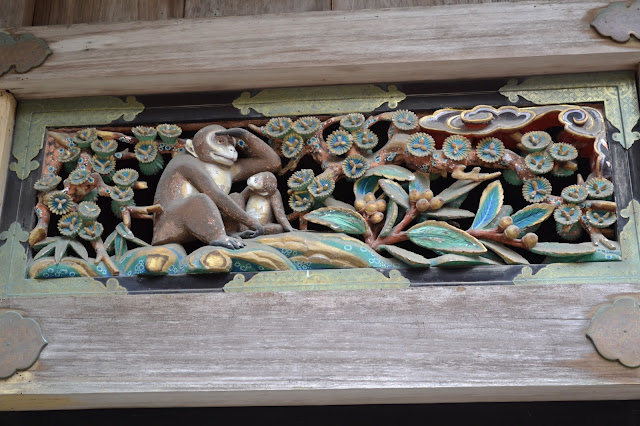 “A mother monkey is looking far into the future of her
child, and a child is looking up at the mother.”
 “Three monkeys tell us that children should see no
evil, say no evil, and hear no evil.”

 “He is ambitiously looking up”
 “He is frustrated in life and desperately looking down
the cliff while one of his friends is cheering him up.”
 “He is love sick.”
 “A newly-wedded couple are going to sail through the
rough waves of life together.”
 “She is an expectant mother, and return to the first
scene.”


 Dragons, probably Kirin though


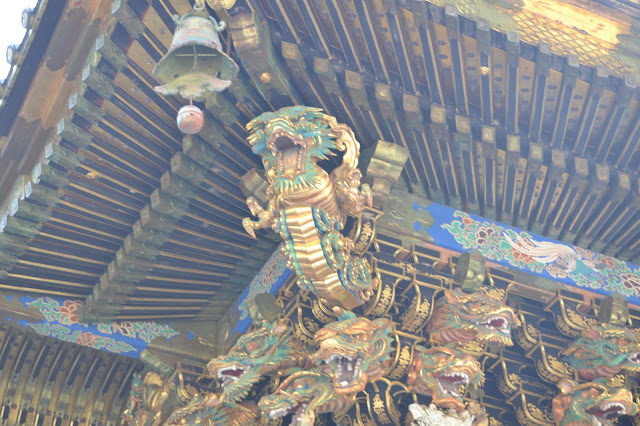 Bad photo of a dragon, but it may actually be a
giraffe. I know, it’s weird.


 Kaizan-Do Sacred Hall is where the body of Priest
Shodo was cremated.
 Next to that is his grave…
 …along with his three disciples

 Behind that was the Hotoke Iwa, which contains six
stone statues of Buddha (called Rokubu-te). They were pretty cool, and it was
weird to just see these statues under a cliff.


