Tuesday, September 3, 2013

大阪 (Osaka)

This past weekend, I decided to go to Osaka. I'll be honest, this place held little interest for me... kinda like the exact opposite of trashy reality MTV shows. In the end, though, I was able to find some pretty interesting stuff. Osaka itself is best known for the Osaka Castle but I did not go there, instead wishing to find some other interesting places.

First off was the Shitenno-ji Temple. Whaa? Another temple?!

Now, I know what you're thinking. This one is special, and I'll tell you why... it's the very first Buddhist temple in Japan, built in 593 by a lovely gentleman known as Prince Shotoku. Small disclaimer -- none of the original temple exists... the last bit was rebuilt in the 1960s.


Prince Shotoku was part of the Soga family, who desired to spread Buddhism throughout all of Japan. They had tried earlier but in what turned out to be a pretty big PR disaster, a plague broke out just as Buddhism was picking up. Another issue was that a rival Japanese clan, the Mononobe family, was all about the Shintoism because they held some official Shinto positions. What's two disagreeing clans to do, especially when it comes to religion? Why have a battle, of course!

Together, Soga Umako (the chieftan of the Soga clan) and Prince Shotoku (nephew of Soga Umako) lead their clan to victory. If you buy the Shotoku version, he won the war by praying to the Shitenno (four Buddhist heavenly guardian kings) and offering them a deal... "I'll build you a temple if I win this one, guys!" Guess who won? No, really, guess. You're right (unless you said Mononobe... then you're wrong and obviously didn't read the first part of this paragraph). Soga Umako put his sister, Empress Suiko, on the throne and she, in turn, made Prince Shotoku the regent. And thus began his lineage and the lifelong building of Buddhist temples.


I tried to get fancy with this one... 


The  above few photos also show the Eirei-do, which was a structure for a big bell created to respect Prince Shotoku. After WW2, the bell was "offered" to the government, the place signifies praying for peace of the world.

Wandering around, we also found a lecture hall (Koudou) that had a really cool pebble yard.


Additionally, I gazed from afar (not really feeling like paying the entry fee) of the Garan complex with a 5-story pagoda called Gojunoto. I believe that inside are the remains of Prince Shotoku (or something like that) and probably a few pretty neat Buddhist things that we aren't allowed to take photos of. You know the drill.


There was also a little pond filled with turtles. It was obvious they were captives to the human race, because when we walked over to look at them, they all furiously swam to get some food. Little did they know that we had no food to speak of... suckers.


The Gokuraku-jodo Garden was offset from the temple, but was designed based on descriptions of the "Western Paradise of Amida Buddha". I looked up the description, and apparently it is a land of beauty that surpasses all other realms. It (Wikipedia) also states that entering the Pure Land is the equivalent of attaining enlightenment... boom.


With the excitement of entering an area reserved for the enlightened behind me, I headed to an area of town called Shinsekai.


This wasn't really the real entrance, because it had a much cooler sign than this 1980s version, but there you go. Shinsekai was originally the "New World", as it was created before WW2 when the Industrial Exposition was held here. Then World War 2 happened and it became its new visage... a seedy, slum-town... and I went there. It was quite interesting to see that in Japan, since they are usually so careful about image. Honestly it wasn't much more dangerous than other parts of Tokyo, but it did look very run down. When it was first created, Shinsekai was designed to look one part Paris and two parts Coney Island. The Coney Island part was filled with stalls serving Osaka's famous food kushikatsu (fried food) -- of which I had none. I know. Pathetic.


I am not sure why I failed to take a photo of it, but the Paris version of Shinsekai includes the Tsutenkaku Tower (Shinsekai's version of the Eiffel Tower)... shamelessly I stole a photograph from someone who left their watermark on it.


I also got my photo taken with Biliken, which is not even a Japanese creation! This scary creature was dreamed up by an American woman and represents "The God of Things as They Ought To Be." I guess if you rub its feet, you'll get good luck.

Unfortunately, I didn't get to see everything else in Osaka because torrential downpours from our friendly local typhoon hit us.... but fear not. If I return again, I'll be sure to hit those places up and type a few (ok, a lot) of words about it.

Monday, September 2, 2013

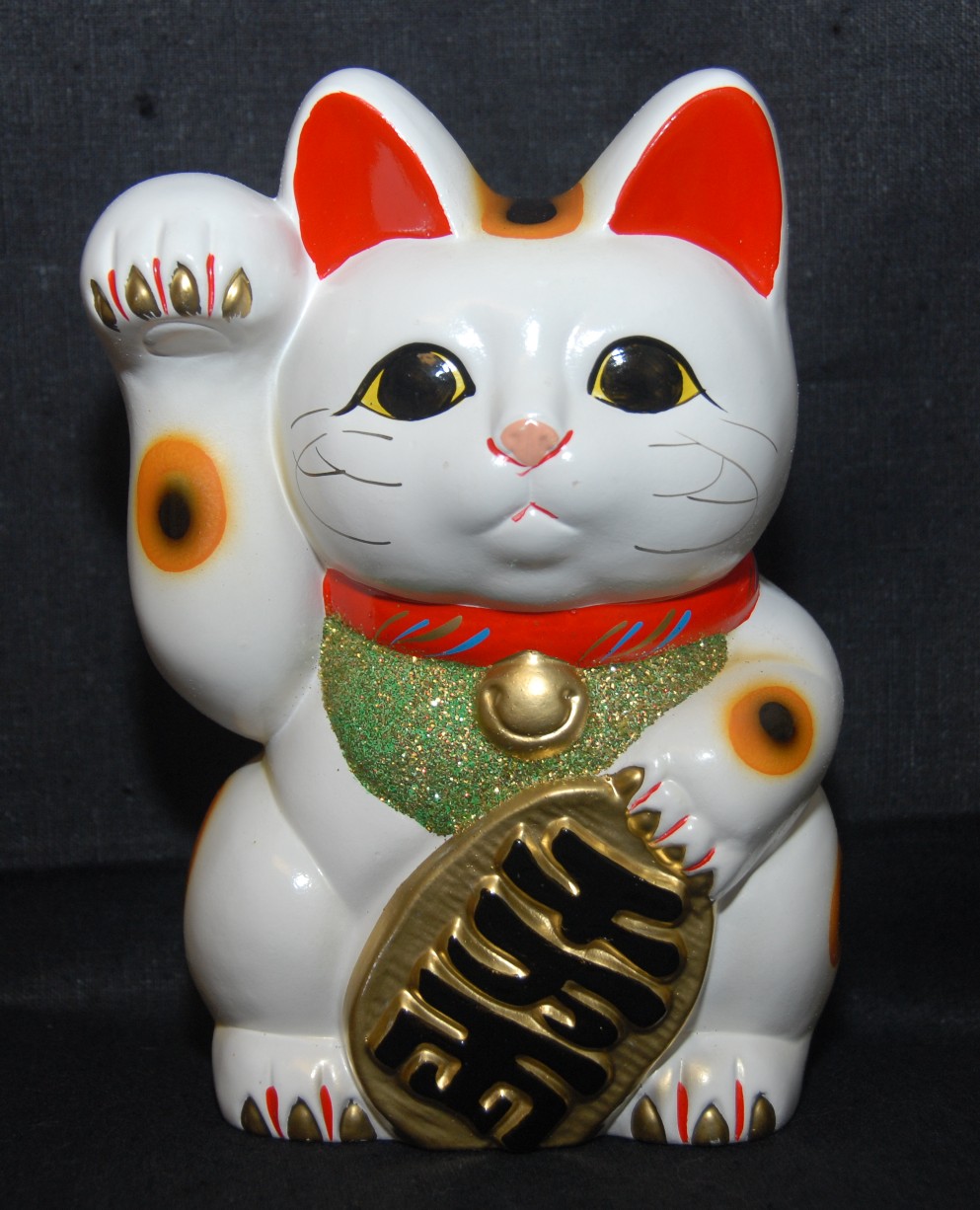
Maneki-Neko (招き猫)

If you spent anytime in Japan, you will soon become familiar with the "Lucky Cat", which is literally (ok, sometimes figuratively) beckoning luck with its little raised paw. Depending on which paw is raised, you either beckon money or luck. The beckoning part is somewhat confusing for westerners, since we usually beckon people by having our palm face upwards and inwards... not so in Japan, my friends! I guess they do it backwards.


Either way, there are apparently two shrines that like to say they are the originator of the Maneki-Neko. WHICH ONE IS LEGIT?! I will let you decide for yourself.

The first one I went to visit is called the Imado Jinja Shrine.


The story of the lucky cat at this shrine comes from a legend of a very poor woman who had a cat. In the ultimate act of betrayal (in my mind), she sold the cat to get whatever money she could... I guess the cat didn't have hard feelings because it came to her in a dream and told her to make clay figurines in its image. She did so and became rich. Lucky.

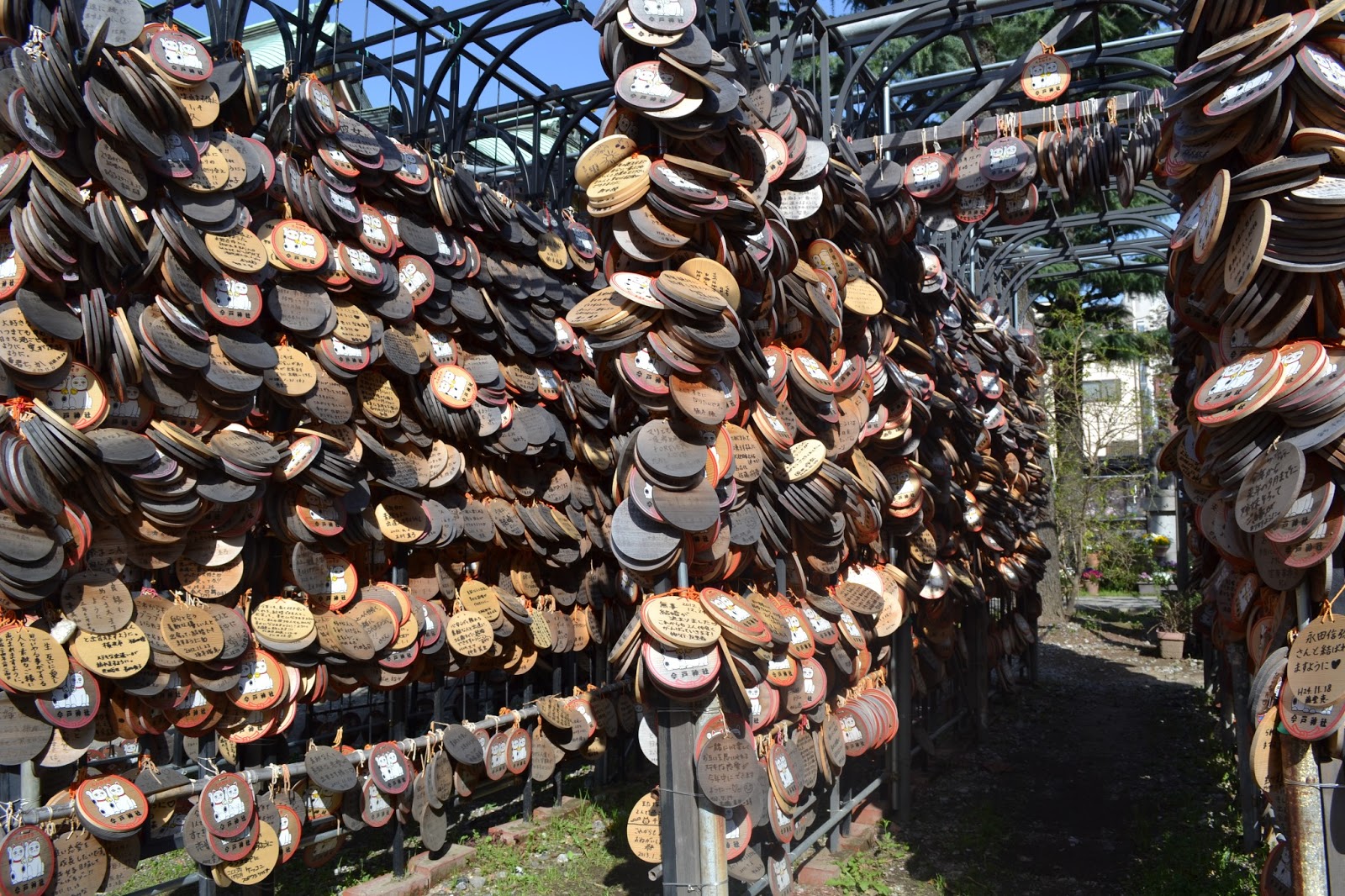
This particular shrine is more about getting married. The cats here are in pairs and represent a male and female finding their love (I guess you could probably confer this on to homosexual couples).


As such, there were TONS of ema written by lonely girls (more likely... I suppose that's sexist) praying for their one true love.


There were also plenty of other lucky cats around the facilities, including a REAL lucky cat!


Following that, I went to Gotoku-ji Temple.


This temple, which apparently is famous for the grave of an important Japanese warrior, is also a "shrine for the cute cats that wave with one arm raised." That's per their little English information sheet, which believe me, I greatly appreciated since English pamphlets are hard to come by.

Anyway, this temple believes that the lucky cat story started in a much different way. Essentially, a monk lived with a cat, and he was very poor (there seems to be a correlation with having a cat and being poor... hmmm). Having enough of this thankless cat, he told it, "If you are grateful to me, bring some fortune to the temple." The cat was able to wave in six samurai warriors to the temple right before the onset of a big storm, which either lead to not getting wet, not getting struck by lightning, or hearing the monk preach Sanzei-inga-no-hou (past, present, future reasoning sermons), depending on your version of the story. I guess the monk was a really great lecturer because the samurai were so "delighted" by it that they donated rice fields and crop lands to make the temple amazing. The cat who was responsible for all this is said to be in this little urn type thing, as pictured, and its grave site was blessed by the monk.


There was also a big pagoda nearby, and a kind old Japanese guy came around and showed me photos of little cat carvings on the pagoda while speaking profusely in Japanese. I only wish I understood him, because I'm sure he was quite informative. Try and squint at my photos to see if you can find the little kitten statues in the pagoda... I bet you can't!


Off to the right of the pagoda was a cool little cat shrine. You can buy your very own ceramic cat and either place it at the shrine (I'm guessing to wish for luck, money or perhaps your dead cat) or bring it back with you. I naturally brought mine back with me... after all, I'm a crazy cat lady!


Gotokuji Temple
2-24-7, Gotokuji, Setagaya-ku, Tokyo
Get off at Odakyu Electric Railway "Gotokuji" Station from Shinjuku, and 5-min walk 
Get off at Tokyu Setagaya Line "Miyanosaka" Station from Sangenjaya, and right outside the station

Imado Shrine 
1-5-22, Imado, Taito-ku, Tokyo
Get off at Tokyo Metro Ginza Line, Asakusa Line or Tobu Isesaki Line "Asakusa" Station, and 15-min walk

Monday, June 24, 2013

硫黄島 (Iwo Jima)

This past weekend, I was lucky enough to go to a place that has great historical significance for Americans... and I guess Japanese. This picture may give you a clue as to where I'm talking about (or you could look at the title of my blog, but that's too easy!).


Or what about...


Yup, Iwo Jima (officially known as "Iwo-to" these days). It's open only to a select few military members, and seeing as I'm part of CVW-5 these days, we use it for "Field Carrier Landing Practice" (FCLP for short) for the non-helicopter squadrons. If you're a n00b like me and have no idea what that means, check out this article for your continual lifelong learning. Since I'm a doctor and not a pilot, I was there to provide medical support. Our clinic was straight out of Catch-22, I swear... like, it was bare bones. Totes.


Those three guys were my lucky (and awesome) corpsman.

I must provide a preface to this blog post. I don't have the maps that explain the different caves so please accept this sword of defeat at your feet for the lack of educational info I'm known for... my internet searching was not helpful since most of it was centered around the battle and not necessarily the modern day island.

My camera almost died from the humidity, so the first picture is very foggy... but I will include it for my dad.


Originally, we wanted to go to Mount Suribachi (the flag raising location) first, but we ended up getting lost. If you realize that Iwo Jima is only about 8 square miles, you'll understand the impressiveness of that last statement. Instead, we found ourselves on Shipwreck Beach, which is a place where reinforced cement ships were placed to create a reef or something like that. Since the tide has gotten so low, it now looks like you're the only survivor in a post-apocalyptic world war.


Next to that beach was a volcanic sulfur pit, so called "Warbler Hell" due to its color (I guess it has the same color as a the Warbler, a Japanese bird). I later heard that someone almost fell into it after the ground gave away, and I felt a little scared that I had gone so close.


Next up was the memorial for the flag raising on the top of Mount Suribachi. It was incredible to see and be present at such an iconic location. There were multiple monuments, one was to the Americans and the rest were to the Japanese.


 I took that one for the corpsman.


From the top you could see Invasion Beach, where the Marines and Seabees first landed. The front wave didn't meet much opposition because General Kuriyabashi wanted to wait until they were all on the beach and then attack. However, the first wave experienced devastating losses from the hidden Japanese.


If you can't tell from the photo, it was freaking hot there. On Invasion Beach, we found one of the old machine guns.


With all that excitement behind us, we then went cave diving. There are hundreds of tunnels around the island that were used by the Japanese, and it was fun to see the more well-known ones. I would try to scare the corpsman by playing creepy classical music while we were crawling around in the dark, dirty caves (alliteration for you right there). We found one that was a medical cave and had tons of old medicine bottles, helmets and rusted weapons. It was very weird to think that someone actually used that before us, and there it was, untouched (sorta). There was also a "Sauna Cave", which is now used as a sauna (clever) by the Japanese because it is so hot.

On the northwest part of the island, we found another monument. Unfortunately, it was all in Japanese so I wasn't able to translate any of it. Also, my trusty internet skillz have failed me in finding out exactly what it was for, so if anyone knows, please feel free to comment on it.


With that, I will leave you with two other photos... one is a picture of a jet at dusk, and the other is a picture of the trusty golf cart that carried us around the island without incident.